RMI (Remote Motion Interface) is a TCP-based protocol that lets you send TP-equivalent motion instructions and administrative commands to a Fanuc controller in real time.
## Robot requirements
- **Option R912** (Remote Motion Interface) must be loaded on the controller.
- The bootstrap port is **16001** (TCP).
- Before calling `Initialize()`, the teach pendant must be **disabled** and the controller must be in **AUTO mode**.
- Do not leave the RMI_MOVE TP program selected on the teach pendant before calling `Initialize()`.
## How it works
1. **Connect** to the controller on the bootstrap port (16001). The controller assigns a working port for the session.
2. Call **`Initialize()`** to create the `RMI_MOVE` TP program and start it.
3. Send motion or non-motion instructions via **`SendTpInstruction()`**. Each call returns an `RmiInstructionResponse` you can track.
4. The client manages the 8-slot controller buffer automatically. Instructions beyond that limit are held locally and sent as soon as a slot is free.
5. When done, call **`Abort()`** or **`Disconnect()`**. Always end your session with one of those; otherwise the controller keeps RMI_MOVE selected and other TP programs cannot run.
## Quick example
**C# : Rmi**
```csharp
using UnderAutomation.Fanuc;
using UnderAutomation.Fanuc.Common;
using UnderAutomation.Fanuc.Rmi.Data;
using UnderAutomation.Fanuc.Rmi.TpInstructions;
public class Rmi
{
static void Main()
{
FanucRobot robot = new FanucRobot();
ConnectionParameters parameters = new ConnectionParameters("192.168.0.1");
parameters.Rmi.Enable = true;
robot.Connect(parameters);
/**/
// Initialize the RMI_MOVE program on the controller.
// TP must be disabled and the controller must be in AUTO mode.
robot.Rmi.Initialize();
// Linear motion at 100 mm/s to a Cartesian target (tool 1, frame 0)
var instr = new LinearMotionTpInstruction
{
SpeedType = RmiLinearSpeedType.MmSec,
Speed = 100,
TermType = RmiTerminationType.Fine,
Target = new CartesianPositionWithUserFrame(500, 200, 300, 0, 90, 0, tool: 1, frame: 0)
};
RmiInstructionResponse r = robot.Rmi.SendTpInstruction(instr);
// Wait for the controller to confirm the motion completed
r.WaitForCompletion();
if (r.Status == RmiInstructionStatus.Error)
System.Console.WriteLine("Error: " + r.ErrorText);
// Abort when done - always end the session with Abort() or Disconnect()
robot.Rmi.Abort();
robot.Disconnect();
/**/
}
}
```
**Python : Rmi**
```python
from underautomation.fanuc.fanuc_robot import FanucRobot
from underautomation.fanuc.connection_parameters import ConnectionParameters
from underautomation.fanuc.rmi.tp_instructions.linear_motion_tp_instruction import LinearMotionTpInstruction
from underautomation.fanuc.rmi.data.rmi_linear_speed_type import RmiLinearSpeedType
from underautomation.fanuc.rmi.data.rmi_termination_type import RmiTerminationType
from underautomation.fanuc.rmi.data.rmi_instruction_status import RmiInstructionStatus
from underautomation.fanuc.common.cartesian_position_with_user_frame import CartesianPositionWithUserFrame
robot = FanucRobot()
parameters = ConnectionParameters("192.168.0.1")
parameters.rmi.enable = True
robot.connect(parameters)
##
# Initialize the RMI_MOVE program on the controller.
# TP must be disabled and the controller must be in AUTO mode.
robot.rmi.initialize()
# Linear motion at 100 mm/s to a Cartesian target (tool 1, frame 0)
instr = LinearMotionTpInstruction()
instr.speed_type = RmiLinearSpeedType.MmSec
instr.speed = 100
instr.term_type = RmiTerminationType.Fine
instr.target = CartesianPositionWithUserFrame(500, 200, 300, 0, 90, 0, 1, 0)
r = robot.rmi.send_tp_instruction(instr)
# Wait for the controller to confirm the motion completed
r.wait_for_completion()
if r.status == RmiInstructionStatus.Error:
print("Error:", r.error_text)
# Abort when done - always end the session with abort() or disconnect()
robot.rmi.abort()
##
robot.disconnect()
```
## Connection
**C# : RmiConnection**
```csharp
using UnderAutomation.Fanuc;
public class RmiConnection
{
static void Main()
{
FanucRobot robot = new FanucRobot();
/**/
// Enable RMI and connect. The bootstrap port is 16001.
// The controller assigns a working port automatically.
ConnectionParameters parameters = new ConnectionParameters("192.168.0.1");
parameters.Rmi.Enable = true;
robot.Connect(parameters);
System.Console.WriteLine("Connected: " + robot.Rmi.Connected);
System.Console.WriteLine("Protocol version: " + robot.Rmi.MajorVersion + "." + robot.Rmi.MinorVersion);
System.Console.WriteLine("Working port: " + robot.Rmi.WorkingPort);
// Subscribe to events before sending instructions
robot.Rmi.SystemFaultReceived += seqId =>
System.Console.WriteLine("System fault on sequence " + seqId);
robot.Rmi.ConnectionTerminated += () =>
System.Console.WriteLine("Controller closed the RMI session");
robot.Rmi.RecordedCartesianPositionReceived += pos =>
System.Console.WriteLine("Recorded position " + pos.PositionId);
robot.Disconnect();
/**/
}
}
```
**Python : RmiConnection**
```python
from underautomation.fanuc.fanuc_robot import FanucRobot
from underautomation.fanuc.connection_parameters import ConnectionParameters
robot = FanucRobot()
##
# Enable RMI and connect. The bootstrap port is 16001.
# The controller assigns a working port automatically.
parameters = ConnectionParameters("192.168.0.1")
parameters.rmi.enable = True
robot.connect(parameters)
print("Connected:", robot.rmi.connected)
print("Protocol version:", robot.rmi.major_version, ".", robot.rmi.minor_version)
print("Working port:", robot.rmi.working_port)
# Subscribe to events before sending instructions
def on_fault(seq_id):
print("System fault on sequence", seq_id)
robot.rmi.system_fault_received += on_fault
def on_terminated():
print("Controller closed the RMI session")
robot.rmi.connection_terminated += on_terminated
def on_pos_recorded(pos):
print("Recorded position", pos.position_id)
robot.rmi.recorded_cartesian_position_received += on_pos_recorded
robot.disconnect()
##
```
## Initialize and status
Call `Initialize()` after connecting. Check the controller state with `GetStatus()` first if needed.
**C# : RmiInit**
```csharp
using UnderAutomation.Fanuc;
using UnderAutomation.Fanuc.Common;
using UnderAutomation.Fanuc.Rmi.Data;
public class RmiInit
{
static void Main()
{
FanucRobot robot = new FanucRobot();
ConnectionParameters parameters = new ConnectionParameters("192.168.0.1");
parameters.Rmi.Enable = true;
robot.Connect(parameters);
/**/
// Check controller state before initializing
RmiControllerStatusResponse status = robot.Rmi.GetStatus();
System.Console.WriteLine("Servo ready: " + status.ServoReady);
System.Console.WriteLine("TP enabled: " + status.TPEnabled);
System.Console.WriteLine("RMI running: " + status.RmiMotionStatus);
// Initialize: creates and starts the RMI_MOVE TP program.
// Will throw if TP is enabled or servos are off.
robot.Rmi.Initialize();
// For multi-group controllers, specify a group mask (bit N = group N+1)
// robot.Rmi.Initialize(groupMask: 0b00000011); // groups 1 and 2
// Enable real-time singularity avoidance (requires MajorVersion >= 6, R792 option)
// robot.Rmi.Initialize(rtsa: true);
// Set palletizing motion mode (requires MajorVersion >= 7)
// robot.Rmi.Initialize(pltzMode: RmiPltzMode.ZeroDown);
System.Console.WriteLine("RMI initialized");
// The controller checks sequence IDs by default.
// AutoSetNextSequenceId() resynchronizes the counter if needed.
robot.Rmi.AutoSetNextSequenceId();
robot.Rmi.Abort();
robot.Disconnect();
/**/
}
}
```
**Python : RmiInit**
```python
from underautomation.fanuc.fanuc_robot import FanucRobot
from underautomation.fanuc.connection_parameters import ConnectionParameters
from underautomation.fanuc.rmi.data.rmi_pltz_mode import RmiPltzMode
robot = FanucRobot()
parameters = ConnectionParameters("192.168.0.1")
parameters.rmi.enable = True
robot.connect(parameters)
##
# Check controller state before initializing
status = robot.rmi.get_status()
print("Servo ready:", status.servo_ready)
print("TP enabled: ", status.tp_enabled)
print("RMI running:", status.rmi_motion_status)
# Initialize: creates and starts the RMI_MOVE TP program.
# Will throw if TP is enabled or servos are off.
robot.rmi.initialize()
# For multi-group controllers (requires MajorVersion >= 2)
# robot.rmi.initialize(group_mask=0b00000011) # groups 1 and 2
# Enable real-time singularity avoidance (requires MajorVersion >= 6, R792 option)
# robot.rmi.initialize(rtsa=True)
# Set palletizing motion mode (requires MajorVersion >= 7)
# robot.rmi.initialize(pltz_mode=RmiPltzMode.ZeroDown)
print("RMI initialized")
# Resynchronize the sequence ID counter if needed
robot.rmi.auto_set_next_sequence_id()
robot.rmi.abort()
##
robot.disconnect()
```
## Instruction pipeline
`SendTpInstruction()` returns an `RmiInstructionResponse` immediately. The instruction goes through several states:
| Status | Meaning |
|--------|---------|
| `LocalQueued` | Held in the client buffer, not yet sent (controller buffer full). |
| `ControllerQueued` | Sent to the controller, waiting its turn. |
| `Executing` | The robot is currently executing this instruction. |
| `Completed` | Done without error. |
| `Error` | Failed. Check `ErrorId` and `ErrorText`. |
Call `WaitForCompletion()` to block until the instruction reaches a terminal state.
## Troubleshooting
### "Connection refused by controller"
`Connect()` throws a `ConnectException` with this message. It is not a network problem: the controller answered on port 16001, then refused the RMI session. The inner exception is an `RmiException`, and its `ErrorId` gives the error code of the controller.
Check:
- Option R912 is loaded on the controller.
- No alarm is active on the teach pendant. Reset the alarms and try again.
- No other RMI session is open. A session that was not ended with `Abort()` or `Disconnect()` keeps `RMI_MOVE` selected. Abort the programs on the teach pendant (`FCTN`, `ABORT (ALL)`), then connect again.
## Try it in the demo application
Everything on this page can be tried without writing code, in the **RMI (R912)** page of the [demo application](/fanuc/documentation/demo-app).
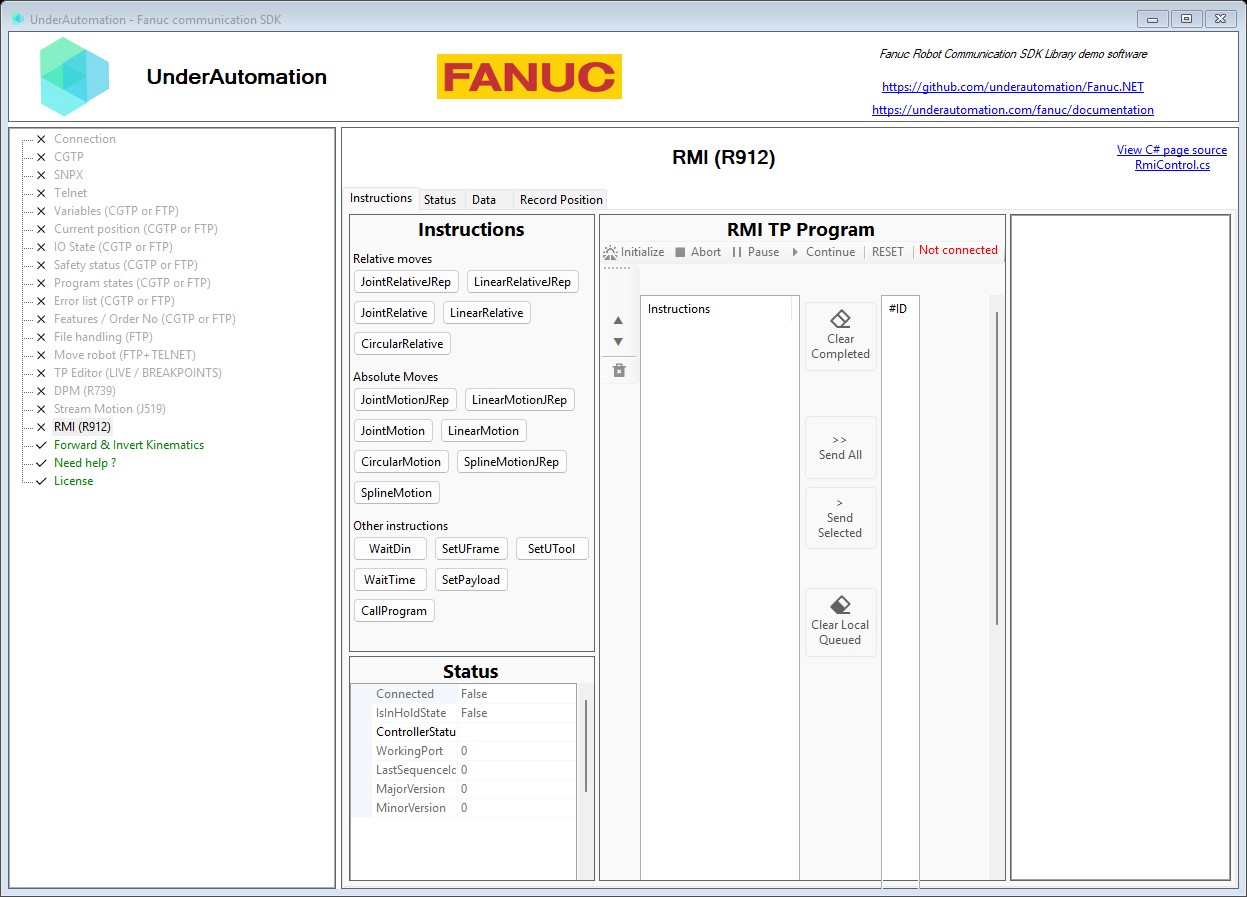
Its C# source is [RmiControl.cs](https://github.com/underautomation/Fanuc.NET/blob/main/UnderAutomation.Fanuc.Showcase.Forms/Components/RmiControl.cs).
## Next steps
- [Motion commands](/fanuc/documentation/rmi-motion): linear, joint, circular, spline motions and non-motion instructions.
- [Frames, I/O & status](/fanuc/documentation/rmi-frames-io): frame management, I/O, position reading, registers.
## API reference
**Members of Rmi.RmiClient**
```csharp
public class RmiClient : RmiClientBase, IDisposable {
// Creates a new instance of the RMI client.
public RmiClient()
// Connect to the FANUC controller using the RMI protocol.
public void Connect(string ip, int port = 16001, int readTimeoutMs = 2000)
}
```
**Members of Rmi.Internal.RmiClientBase**
```csharp
public abstract class RmiClientBase : IDisposable {
// Creates a new instance of the RMI client.
public RmiClientBase()
// Abort the running motion program. Note that a Reset() will be called automatically if the controller is in the HOLD state.
public void Abort()
// Calls internally and set only if $RMI_CFG.$Chk_seqID = FALSE. It also set to $RMI_CFG.$Chk_seqID.
public RmiControllerStatusResponse AutoSetNextSequenceId()
// Indicates whether the controller checks for consecutive sequence IDs in motion instructions ($RMI_CFG.$Chk_seqID). Modified by .
public bool CheckSequenceId { get; set; }
// Removes all instructions with a terminal status (
// or ) from the tracked instruction list.
// Instructions that are still pending or in progress are not affected.
public void ClearCompletedInstructions()
// Cancels and removes all instructions that are still in the local client buffer
// (). These instructions have not been sent
// to the controller yet. Each cancelled instruction is marked with an error so that any
// thread blocked on is unblocked.
// Instructions already sent to the controller are not affected.
public void ClearLocalQueuedInstructions()
// Connect to the controller: perform the bootstrap handshake on the given port,
// obtain the working port, then switch to it for all subsequent commands.
protected void ConnectInternal(string host, int port, int readTimeoutMs = 2000)
// Indicates that the client is currently connected to the controller working port.
public bool Connected { get; }
// Fired when the controller closes the session (e.g. communication idle timeout).
// The client is automatically disconnected after this event fires.
public event Action ConnectionTerminated
// Resume a paused motion program.
public void Continue()
// Disconnect from the controller by sending the disconnect command on the working port.
// Safe to call even when already disconnected.
public void Disconnect()
// Disconnect from the controller and release resources.
public void Dispose()
// Get extended controller status including drive power state and speed clamp.
public RmiExtendedControllerStatusResponse GetExtendedStatus()
// Get the current controller and RMI motion status.
public RmiControllerStatusResponse GetStatus()
// Get the current UFRAME and UTOOL numbers.
public RmiUFrameUToolNumbersResponse GetUFrameUTool(byte? group = null)
// Initialize RMI and start the motion program. Must be called before sending any motion instructions.
// It also Resets and empty the instruction buffer
public void Initialize(byte? groupMask = null, bool? rtsa = null, RmiPltzMode? pltzMode = null)
// All instructions submitted since the last or explicit clear,
// in submission order. Includes instructions in all states: ,
// , ,
// and .
// Returns a snapshot array; the array is not updated after it is returned.
public RmiInstructionResponse[] Instructions { get; }
// Indicates that the controller has entered the HOLD state and will not accept new TP instructions
// until is called.
//
//
// The HOLD state is entered in two situations:
//
// -
// An invalid sequence ID was detected (error RMIT-029, error code 2556957). RMI checks that sequence IDs are
// consecutive. If a gap is found, RMI rejects the instruction and enters HOLD. The controller continues
// executing the TP instructions already queued but blocks all new ones. Use
// to recover the correct sequence ID, then call before resuming.
//
-
// An invalid motion instruction was received (error RMIT-024, error code 2556952), for example a motion
// option that is not loaded on the controller. RMI returns an error for that instruction, puts the
// controller in HOLD, and continues executing any instructions already in the TP program queue. Call
// once the problem is corrected, then resume sending instructions.
//
//
// All instructions sent while in the HOLD state are ignored by the controller and returned with an error code.
// This flag is cleared automatically when succeeds.
//
public bool IsInHoldState { get; }
// Sequence ID used for the last instruction sent to the controller. Reset to 0 by .. Modified by .
public int LastSequenceId { get; }
// Controller protocol major version reported during the connection handshake.
public short MajorVersion { get; }
// Controller protocol minor version reported during the connection handshake.
public short MinorVersion { get; }
// Pause the running motion program.
public void Pause()
// Read current Cartesian TCP position.
public RmiCartesianPositionResponse ReadCartesianPosition(byte? group = null)
// Read a digital input port value.
public RmiDigitalInputValueResponse ReadDIN(short portNumber)
// Read the most recent controller error text. Up to 5 consecutive errors can be requested.
public RmiControllerErrorTextResponse ReadError(byte? count = null)
// Read a generic IO port (DI, DO, AI, AO, GO, RO, FLAG, RI, UI, UO).
public RmiIoPortValueResponse ReadIOPort(RmiIoPortType portType, int portNumber)
// Read current joint angles.
public RmiJointAnglesSampleResponse ReadJointAngles(byte? group = null)
// Read a numeric register
public RmiNumericRegisterValueResponse ReadNumericRegister(int number)
// Read a position register
public RmiPositionRegisterDataResponse ReadPositionRegister(short number, byte? group = null)
// Read the current TCP speed in mm/s.
public RmiTcpSpeedResponse ReadTcpSpeed()
// RMI connection parameters used during Connect().
public int ReadTimeoutMs { get; }
// Read the UFRAME at the given index.
public RmiIndexedFrameResponse ReadUFrame(byte number, byte? group = null)
// Read the UTOOL at the given index.
public RmiIndexedFrameResponse ReadUTool(byte number, byte? group = null)
// Read a system variable by name (name must include the leading $ character).
public RmiVariableValueResponse ReadVariable(string name)
// Fired when the controller sends a Cartesian position via the RMI Position Record menu.
public event Action RecordedCartesianPositionReceived
// Fired when the controller sends a joint position via the RMI Position Record menu.
public event Action RecordedJointPositionReceived
// Reset controller errors and exit the HOLD state.
public void Reset()
// Sends the instruction to the controller, which queues it.
// Returns an that tracks execution.
public RmiInstructionResponse SendTpInstruction(RmiInstructionBase instruction)
// Set the program speed override (1–100 %).
public void SetOverride(byte value)
// Define payload compensation parameters for a payload schedule.
public void SetPayloadCompensation(byte scheduleNumber, float massKg, float cgXm, float cgYm, float cgZm, float inertiaXkgm2, float inertiaYkgm2, float inertiaZkgm2, byte? group = null)
// Define payload compensation parameters for a payload schedule.
public void SetPayloadCompensation(RmiSetPayloadCompensationParameters p)
// Immediately apply a payload schedule to the active group (command, not an instruction).
public void SetPayloadSchedule(byte scheduleNumber, byte? group = null)
// Define payload mass, center of gravity, and optionally inertia for a payload schedule.
public void SetPayloadValue(byte scheduleNumber, float massKg, float cgXm, float cgYm, float cgZm, float? inertiaXkgm2 = null, float? inertiaYkgm2 = null, float? inertiaZkgm2 = null, byte? group = null)
// Define payload mass, center of gravity, and optionally inertia for a payload schedule.
public void SetPayloadValue(RmiSetPayloadParameters p)
// Set the current UFRAME and UTOOL numbers.
public void SetUFrameUTool(byte uframe, byte utool, byte? group = null)
// Fired when the controller reports a system fault on a given sequence.
// The argument is the SequenceID of the faulted instruction (0 when unknown).
public event Action SystemFaultReceived
// Fired when the controller sends a response that the SDK does not know.
public event Action UnknownPacketReceived
// Working port returned by the controller; all commands use this port after connection.
public int WorkingPort { get; }
// Write a digital output port value.
public void WriteDOUT(short portNumber, RmiOnOff value)
// Write a generic IO port (AO, GO, DO, RO, FLAG).
public void WriteIOPort(RmiIoPortType portType, int portNumber, double value)
// Write a float value to a numeric register
public void WriteNumericRegisterAsDouble(int number, double value)
// Write an integer value to a numeric register
public void WriteNumericRegisterAsInteger(int number, int value)
// Write a Cartesian position register
public void WritePositionRegisterCartesian(short number, CartesianPositionWithUserFrame target, byte? group = null)
// Write the UFRAME at the given index.
public void WriteUFrame(byte number, XYZWPRPosition position, byte? group = null)
// Write the UTOOL at the given index.
public void WriteUTool(byte number, XYZWPRPosition position, byte? group = null)
// Write a float value to a system variable (name must include the leading $).
public void WriteVariableAsDouble(string name, double value)
// Write an integer value to a system variable (name must include the leading $).
public void WriteVariableAsInteger(string name, int value)
}
```
**Members of Rmi.Data.RmiInstructionResponse**
```csharp
public class RmiInstructionResponse : RmiResponseBase {
public RmiInstructionResponse()
public override bool Equals(object obj)
public override int GetHashCode()
// Sent instruction
public RmiInstructionBase Instruction { get; }
// Sequence identifier assigned to this instruction. 0 until the instruction has been dispatched to the controller.
public int SequenceId { get; }
// Current execution state of the instruction.
public RmiInstructionStatus Status { get; }
// Fired each time changes. The argument is the new status value.
// This event may be raised from a background thread.
public event Action StatusChanged
public override string ToString()
// Blocks the calling thread until the instruction reaches a terminal state
// ( or ),
// or until timeoutMs milliseconds have elapsed.
// Pass -1 (or omit) to wait indefinitely.
public bool WaitForCompletion(int timeoutMs = -1)
}
```
**Members of Rmi.Data.RmiControllerStatusResponse**
```csharp
public class RmiControllerStatusResponse : RmiResponseBase {
public RmiControllerStatusResponse()
// Indicates the value of $RMI_CFG.$Chk_seqID, which is the configuration value that determines whether the controller checks valid incremented sequence IDs on incoming instructions.
public bool CheckSequenceId { get; }
public override bool Equals(object obj)
public override int GetHashCode()
// The next valid sequence ID. This key is only valid if the system variable $RMI_CFG.$Chk_seqID = TRUE
public int? NextSequenceId { get; set; }
// Number of user frames available in the robot controller
public byte NumberUFrame { get; set; }
// Number of user tools available in the robot controller
public byte NumberUTool { get; set; }
// RMI_MOVE program status
public TaskStatus ProgramStatus { get; set; }
// The Remote Motion Interface is running
public bool RmiMotionStatus { get; set; }
// The robot controller is ready for motion
public bool ServoReady { get; set; }
// Single step mode
public bool SingleStepMode { get; set; }
// The current speed override setting (1–100).
public byte SpeedOverride { get; set; }
// Teach Pendant Enabled (Switch on position ON) The Remote Motion interface only works when the teach pendant is disabled
public bool TPEnabled { get; set; }
public override string ToString()
}
```