AbbVie: Automating High-throughput screening
How AbbVie Leverages Universal Robots SDK to Automate High-Concentration Protein Screening.

Biotech / Pharma
Universal Robots
High Throughput
.NET SDK
Case Study: How AbbVie Leverages Universal Robots SDK Integration to Automate High-Concentration Protein Screening
In the competitive landscape of biopharmaceutical research, the speed at which a company can transition from molecular discovery to a stable, injectable drug is a primary differentiator. Recently, AbbVie, a global leader in innovative therapies, published a research paper detailing a sophisticated automation breakthrough. By integrating a Universal Robots UR5e with a bespoke software architecture, their team has successfully bypassed traditional laboratory bottlenecks in high-concentration protein formulation.
This use case highlights how the right software interface transforms a standard robotic arm into a highly specialized scientific instrument.
Research Paper: https://www.sciencedirect.com/science/article/pii/S2472630324000451

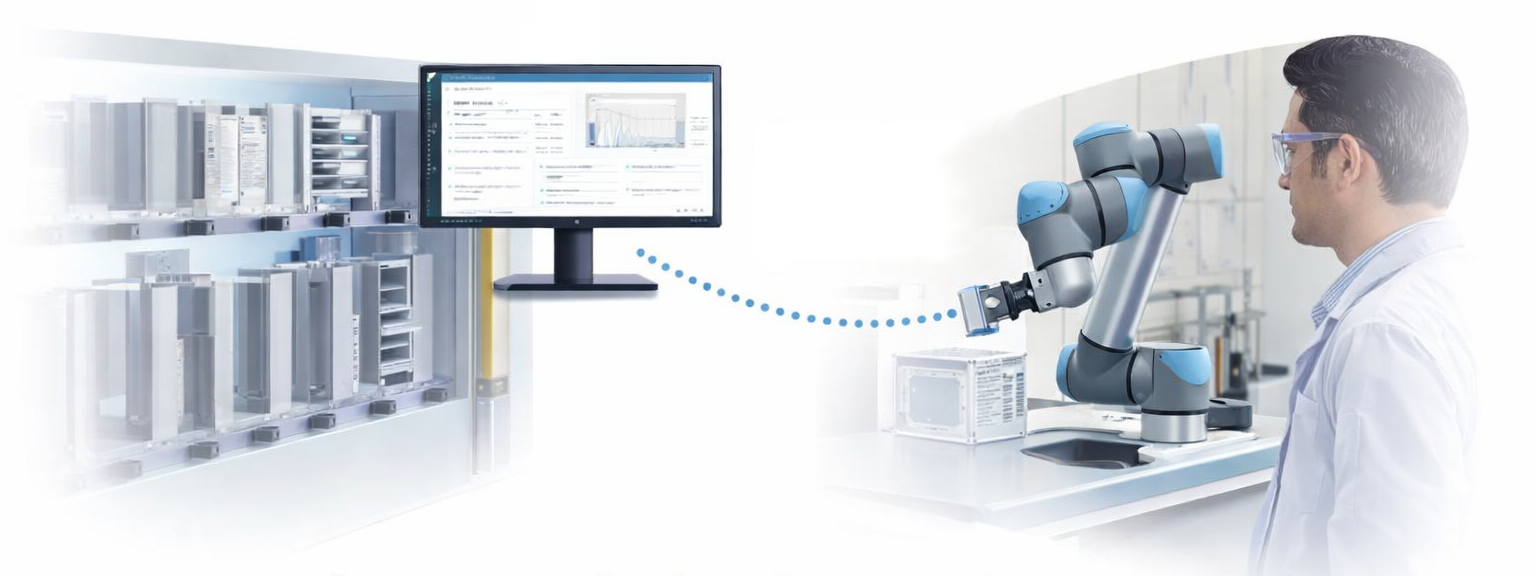
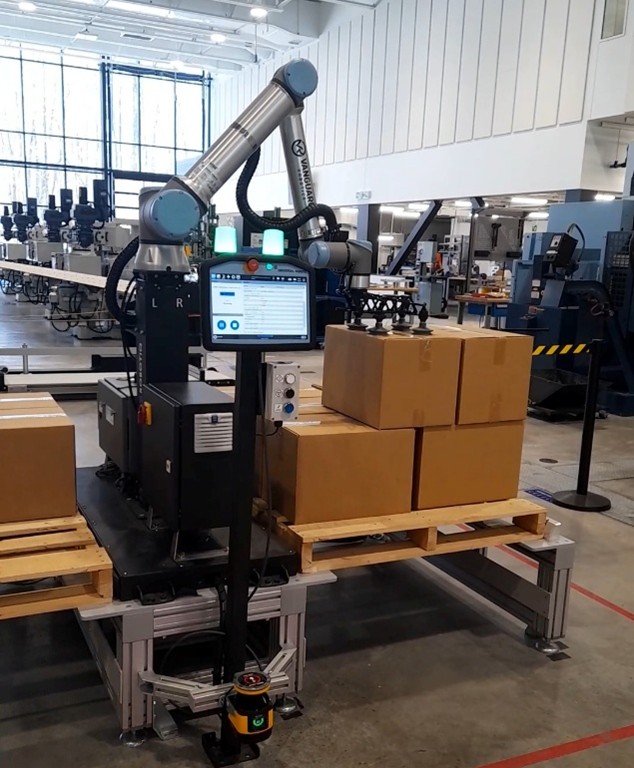
Caption: AbbVie's industrial automation system.
AbbVie: Engineering the Future of Biotherapeutics
AbbVie is a research-driven biopharmaceutical company focused on tackling complex health challenges, from chronic autoimmune diseases to oncology. In the realm of biologics, the company is pushing for high-concentration formulations (>100 mg/mL). These formulations are critical for patient-centric care, as they enable small-volume subcutaneous injections that patients can administer themselves at home.
However, as protein concentration increases, so does viscosity. Handling these "thick" liquids requires a level of precision and consistency that manual pipetting simply cannot achieve at scale.
The Technical Challenge: Beyond the Teach Pendant
To automate the screening of hundreds of buffer and protein combinations, AbbVie needed more than just a robot; they needed a fully integrated ecosystem. Standard robotic interfaces (like the Teach Pendant) are designed for general-purpose tasks but lack the granular control required for high-throughput MS (Mass Spectrometry) analysis and complex plate-handling "hotel" operations.
The researchers identified a need for a centralized control system that could orchestrate the robot, the analytical instruments, and the scheduling logic simultaneously.
The Solution: A Custom Orchestration Layer
AbbVie developed a sophisticated control application that acts as the "brain" of the operation. This software doesn't just tell the robot to move; it manages the entire experimental lifecycle.
User-Centric Software Design
The team built a dedicated graphical user interface (GUI) that allows operators to configure experiments without writing a single line of code. Through this interface, researchers can:
- Define "hotel" operations (sourcing and storing plates).
- Specify destination locations and scan methods.
- Configure the number of plates for each assay.

Caption: The AbbVie Winforms interface allows for seamless queuing of laboratory tasks and real-time experiment tracking.
Optimized Scheduling for Zero Idle Time
One of the most impressive features of the AbbVie system is its internal scheduler. To maximize the ROI of expensive equipment like the IR-MALDESI-MS (Mass Spectrometer), the software ensures the system is never idle. While one plate is being assayed, the scheduler commands the UR5e to fetch and prepare the next plate in the queue. This concurrent workflow ensures that the analytical instruments operate at 100% capacity.
Deep Dive: Native Script Generation via Primary Interface
For maximum efficiency and speed, AbbVie’s engineering team moved away from standard "point-and-click" programming. Instead, they utilized the robot's Primary Interface protocol.
Their software programmatically constructs URScripts, the low-level language the UR controller uses "under the hood." By building these scripts on the PC and sending them directly to the UR5e over the network, they achieved:
- Lower Latency: Commands are executed instantly without manual intervention.
- Dynamic Adaptability: The scripts are generated on-the-fly based on the specific inputs provided in the Winforms GUI.
- Seamless Integration: The robot behaves as a native extension of the .NET environment, allowing for complex error handling and data logging.
Conclusion: The Power of the SDK Approach
While the robot provides the "muscles," it is the software integration, specifically the ability to communicate via the Primary Interface and RTDE, that provides the "intelligence."
By bypassing the limitations of the Teach Pendant and building a custom .NET-based control layer, AbbVie has:
- Drastically increased throughput for high-viscosity formulations.
- Reduced human error in complex plate-queuing tasks.
- Minimized instrument downtime through intelligent scheduling.
For developers and researchers, this use case proves that with the right SDK, the possibilities for Universal Robots in life sciences are virtually limitless.
고객 성공 사례
고객이 UnderAutomation 솔루션을 산업 프로젝트에 어떻게 통합하는지 알아보세요.